This is how one of my most miserable 🥴 experiences in teaching started:
“Can you summarize the story?”
It seemed simple enough, but for my English learners, it was a nightmare.
They were third graders and we had just finished reading a third-grade text called My Rows and Piles of Coins. Heard of it?
It’s hard to summarize.
Even for me.
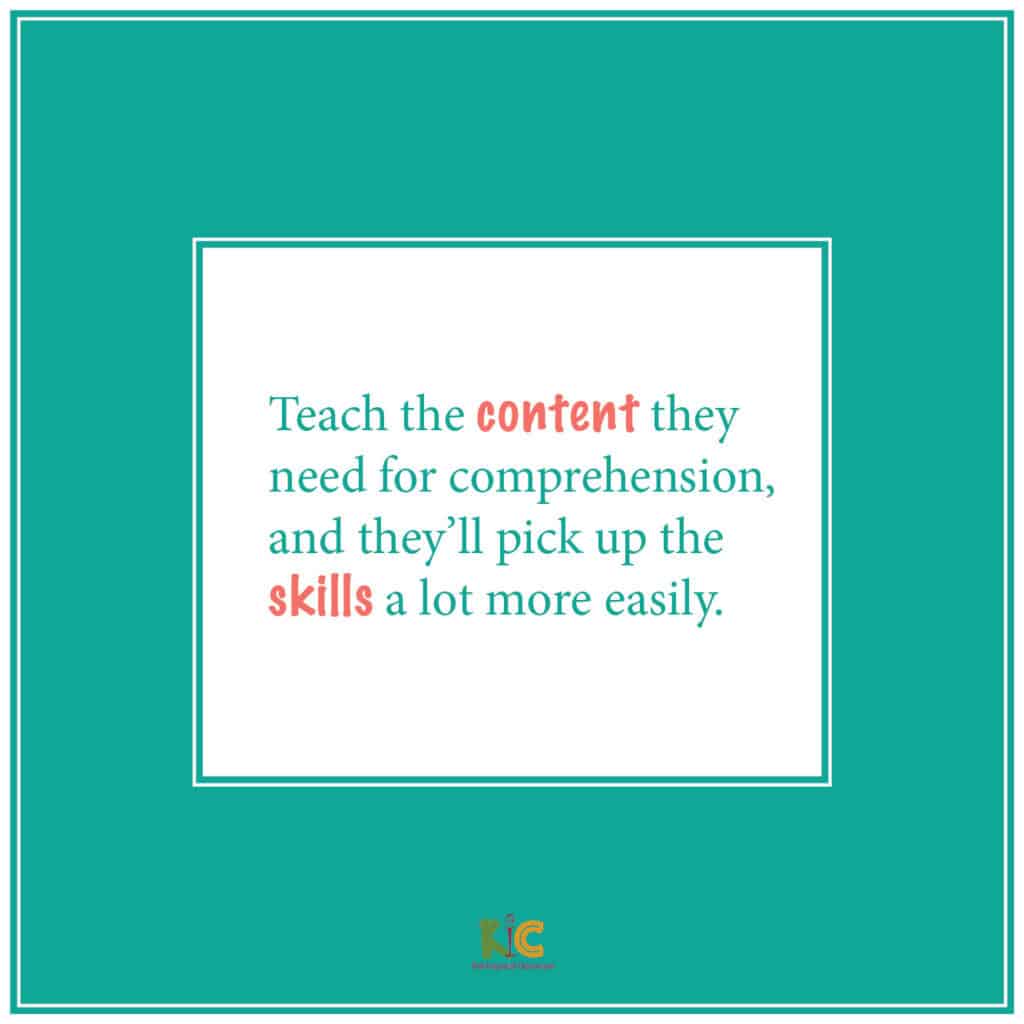
That was one of the first times I really felt strongly that content must come before skill. Students are unable to bring skills to bear on a text they do not understand.
I used to think that if they just used the right skills, they would be able to make meaning from the text, extract the most important details, and summarize the story.
If they could just…
- pay attention to the main idea and supporting details,
- look for key words,
- utilize images and headlines,
…then they would be able to make sense of what they were reading.
They couldn’t…and we wasted an enormous amount of time trying.
Although these literacy skills can help a student who has already understood a text understand and organize the information from a text better…
…practicing these skills will do precious little to help a student who hasn’t understood a text.
And will, very likely, waste a lot of precious time that could have been better spent focusing on things that would have helped.
This is true for students whose first language is English.
It is doubly true for English learners trying to access grade-level content 😳 .
When we focus too much on comprehension skills and not enough on the actual content, we often send students into “introspective nightmares.“
That’s a phrase that comes from David Pearson and quoted in this Forbes article by Natalie Wexler, the author of the book The Knowledge Gap.
In Natalie Wexler’s words:
“The evidence suggests that the way to boost reading comprehension is to build kids’ knowledge—ironically, through the very subjects that schools are pushing aside to spend more time on comprehension skills…If you don’t have enough knowledge and vocabulary relating to the topic to make at least some sense of the text, neither kind of technique [skills or strategies] will help you.”
Let’s avoid putting our students through “introspective nightmares.”
Let’s focus instead first on the far more interesting content of the texts we are reading.
And AFTER students have gained an understanding of the vocabulary and concepts…
…then we can ask students to analyze those texts using reading skills and strategies.