Try out sentence patterning charts with your ELLs to help build vocabulary and writing skills in an engaging way. You can grab some free resource downloads for this activity by clicking the button below.
Duration: 10-20 minutes
Type: Individual or Small Groups
What You Will Need to Practice ESL Vocabulary with Sentence-Pattern Charts
- List(s) of Target Words or Small Vocabulary Flashcards with Images and/or Words (See Below)
- Sentence Chart (See Below)
Download Resources: Scroll to the end of this article to download resources for this activity.
Examples
You can grab a couple of these resources below. If you need more, you can get students to draw their own after brainstorming ideas, or you can find a whole catalogue of of these resources in the Kid-Inspired ESL Curriculum Membership.

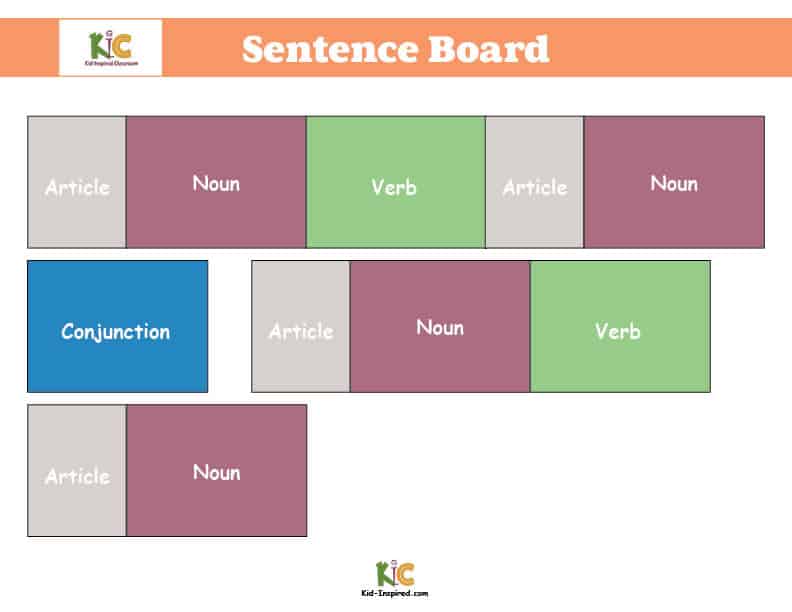
An Example of a Single-Sentence Sentence-Pattern Chart

Small Vocabulary Flashcards That Can Be Cut Out

An Example of a Multiple-Choice Sentence-Pattern Chart Where You Can Put Lots of Words into Each Column

Small Flashcards with Just Words Both Singular & Plural (With Verbs, You Need One Card with Each Form of the Verb)
Overview of This Activity
This activity was inspired in part by Katie Toppel. She’s always posting great ideas on Twitter and she also manages an incredible online Book Club for teachers of English learners.
This activity can be used to practice a set of target vocabulary or respond to a reading passage. Students get into small groups. Each group gets a Sentence Patterning Chart with a sentence frame on it as well as a stack of small vocabulary flashcards with words they can organize onto the chart. Students get in groups and organize vocabulary flashcards onto the Sentence Chart. If you don’t have flashcards, a word bank on the board can work well too. Students then write on their sentence patterning charts. Afterward, students practice sharing their sentences with each other and then committing the sentences to writing.
How to Organize Sentence-Pattern Charts for ESL Vocabulary Practice
- Choose a list of target vocabulary words or a reading passage you’d like them to respond to.
- Prepare enough sets of pictures and vocabulary words for each group to have a set. (If you want to do this activity on the fly, you can alternatively brainstorm lists of words on the board with your students. If you need sets of themed vocabulary, you can join the Kid-Inspired ELL Curriculum Membership for access to our library of vocabulary themes perfoect for this activity.)
- Print off a Sentence Patterning Chart for students to organize the words onto.
- Split students up into groups.
- Students discuss what sentence they’d like to make and put the flashcards onto the sentence chart. Words can easily be replaced or reorganized to make new sentences or you can have them make multiple sentences at a time on the chart.
- They share the sentences they’ve created. This works well if you have students from one group share with another group. We want to keep whole class sharing to a minimum in order to avoid having too many students sitting around waiting while only a single student participates.
- They write the sentences when they’re done. They can write the sentence they created on the sentence board or a new sentence if they’d like. I like to allow students to use humor in order to make the activity more engaging. You can even use it a little like Madlibs. You can check out this activity on using Madlibs for writing for more ideas.
- For essays, you can provide them with a “Paragraph Frame” or “Essay Frame” where they can plug in the sentences they’ve created and fill in a few blanks for the topic sentence/paragraph and concluding sentence/paragraph.

Benefits of Sentence-Pattern Charts for ESL Vocabulary Practice
- Students become more fluent with the words and sentence structures, having used them repeatedly in meaningful contexts.
- Much more hands-on approach to learning parts of speech (i.e. adjectives, nouns, verbs, prepositions, conjunctions, etc.) and other parts of a sentence (i.e. prepositional phrases).
- Small teams keep everyone involved.
- Students practice also get excellent grammar practice by putting together well-structured sentences.

Have you tried this activity? How did it go? Leave your comments below!