
Does this sound familiar? Your English learners can fill in grammar worksheets, but when it’s time to actually speak using different verb tenses, they freeze. Or they mix up “I go,” “I went,” and “I will go” in the same sentence.
The problem isn’t that they don’t know the rules—it’s that they haven’t practiced switching between tenses in actual conversation. That’s where this speaking resource comes in.
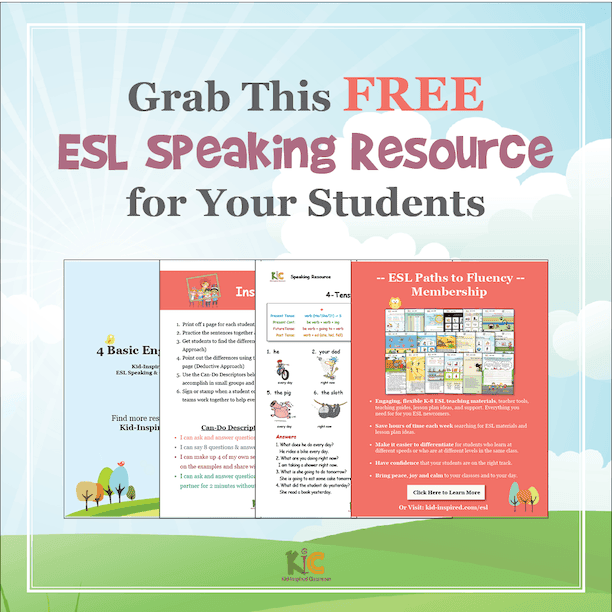
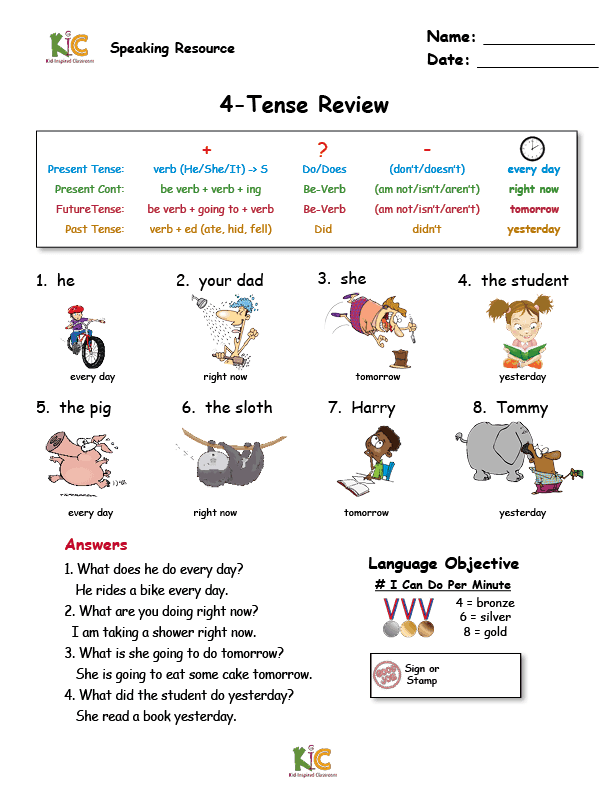
This free 4 Basic English Tenses activity gives your beginning to intermediate ELLs (WIDA levels 2-4) structured practice moving between present simple, past simple, present continuous, and future tenses—with the scaffolding they need to actually succeed.
I work hard to send only stuff that ESL teachers look forward to receiving.
How to Use This Verb Tense Speaking Activity in Your ESL Classroom (15-25 minutes)
Best For: Beginning to intermediate ELLs (WIDA levels 2-4) | Grades 3-12 | Pairs or small groups
What’s Included: One printable page with:
– 4 visual grammar guides (one per tense)
– 16 model question-answer pairs (4 per tense)
– Can-Do challenge checklist
Step-by-Step Implementation:
- Print & Preview (5 minutes)
- Print 1 page per student or laminate for reuse
- Preview vocabulary: Check that students know “play soccer,” “eat breakfast,” etc. Pre-teach if needed for newcomers
- Model & Choral Practice (5-7 minutes)
- Display one tense section on the board
- Model the first question-answer pair with exaggerated intonation
- Practice chorally: “Do you play soccer? Yes, I play soccer every day.”
- Point to the grammar guide: “Notice: Do you + base verb. Yes, I + base verb.”
- Repeat with 2-3 examples from EACH tense section
- Inductive Discovery (Optional, 5 minutes)(Best for grades 6-12)
- Partners find and highlight the differences between tenses
- Guiding questions: “What words change? What stays the same? When do we use each one?”
- Guided Pair Practice (5-10 minutes)
- Partners practice questions and answers, starting with one tense
- Gradually add tenses: “Now try switching from present to past.”
- Teacher circulates, corrects pronunciation, models stress and intonation
- Can-Do Challenges (Differentiated)
- Students choose challenges based on readiness (see below)
- Sign/stamp student pages when they demonstrate mastery
Differentiation Tip: Newcomers (WIDA 1-2) can start with just 2 tenses (present simple and present continuous). Intermediate students (WIDA 3-4) should aim for all 4 tenses plus creating original sentences.
Differentiated Speaking Challenges for Beginning to Intermediate ELLs
Students progress through challenges as they’re ready. Sign or stamp when demonstrated successfully.
- 🌟 I can ask and answer questions in 2 tenses (present simple & present continuous) – WIDA 2
- What Success Looks Like: Student responds accurately with 4 Q&A pairs in 2 tenses, using the resource as support
- Scaffolding Tip: Let them read directly from the page; focus on pronunciation
- 🌟🌟 I can ask and answer questions in all 4 tenses – WIDA 2-3
- What Success Looks Like: Student switches between tenses with occasional errors but self-corrects
- Scaffolding Tip: Point to grammar guide if they get stuck
- 🌟🌟🌟 I can say 8 questions & answers in one minute (fluency challenge) – WIDA 3-4
- What Success Looks Like: Student demonstrates automaticity; minimal hesitation
- Scaffolding Tip: Time with a partner; accuracy matters less than flow
- 🌟🌟🌟🌟 I can create 4 original sentences based on the models – WIDA 3-4
- What Success Looks Like: Student generates novel Q&A pairs: “Did you watch TV? No, I watched YouTube.”
- Scaffolding Tip: Provide sentence frames: “Did you _____? Yes, I _____ yesterday.”
- 🌟🌟🌟🌟🌟 I can interview a partner for 2 minutes without stopping – WIDA 4+
- What Success Looks Like: Student sustains conversation, mixing tenses naturally, using follow-up questions
- Scaffolding Tip: Challenge: No repeating questions
Assessment Tip: Use this as a formative “check for understanding” rather than a graded assignment. Students can retry challenges multiple times.
Quick Tips: Making Tense Practice Communicative
📌 The #1 mistake teachers make: Having ELLs fill out tense worksheets instead of actually SPEAKING with different tenses. Grammar knowledge ≠ speaking ability.
📌 The fix: Give students 10 minutes of tense-switching conversation practice 3x per week. Fluency builds with repetition.
📌 Scaffold like this:
- Week 1: One tense at a time with choral practice
- Week 2: Two tenses, partner practice
- Week 3: All four tenses, fluency challenges
- Week 4: Student-created questions
📌 Don’t correct during fluency practice! Note errors, address after. Interrupting kills confidence.
📌 Make it relevant: Replace example sentences with topics your students care about (video games, sports, music, food from their cultures).
📌 Turn it into a game: “Tense Switch!” Teacher calls out a tense, students have 5 seconds to ask a question in that tense.
📌 Assessment shortcut: The Can-Do challenges ARE your assessment. No separate quiz needed.
Frequently Asked Questions
What proficiency levels is this appropriate for?
This resource works best for beginning to intermediate English learners (WIDA levels 2-4 or TESOL Beginning/Intermediate). Newcomers (WIDA 1) can use a modified version with just 2 tenses and picture support. Advanced ELLs (WIDA 5+) can use this as a quick review or as a model to create their own tense-comparison activities.
Which 4 tenses are included?
- Present Simple (Do you play soccer?)
- Present Continuous/Progressive (Are you eating breakfast?)
- Past Simple (Did you go to school yesterday?)
- Future Simple with “will” (Will you watch TV tonight?)
These are the foundational tenses ELLs need for everyday conversation.
Can I use this with mixed proficiency levels?
Absolutely! The Can-Do challenges are differentiated. Lower-level students can focus on 2 tenses with support from the page, while higher-level students create original sentences and aim for fluency challenges.
How do I handle students who mix up tenses?
This is completely normal! The resource is designed to build awareness of differences through repeated practice. When students mix tenses:
- Don’t interrupt during fluency practice
- Note errors and address AFTER they finish speaking
- Point to the grammar guide: “You said ‘I go yesterday.’ Look here—for past, we say ‘I went.'”
- Have them repeat correctly 3 times
Do students need to understand grammar terminology?
No! While the grammar guides use terms like “present simple,” students can succeed by recognizing patterns. Younger learners (K-5) can simply call them “today sentences,” “right now sentences,” “yesterday sentences,” and “tomorrow sentences.”
What if my students struggle with the vocabulary in the examples?
Pre-teach or substitute! Before starting, quickly check: Do they know “play soccer,” “eat breakfast,” “watch TV”? You can also have students write in different verbs they DO know: “play Fortnite,” “eat rice,” “watch YouTube.”
How does this fit with WIDA or state ELD standards?
This activity addresses:
- WIDA Speaking Standard: “Retell events using a sequence of sentences” (present and past)
- WIDA Language of Language Arts: Verb tenses and time markers
- Most state ELD frameworks include verb tense accuracy as a key grammar feature for intermediate proficiency
Ready to Get Your Students Actually Speaking with Different Tenses?
✅ Download the free resource below
Tell me where to send your FREE speaking resource — 4 Basic English Tenses.
![[Download] Vocab Lesson for ELLs – Occupations!](https://kid-inspired.com/wp-content/uploads/2025/09/Occupations-Vocabulary-Theme-1024x536.jpg)
![Icebreaker Questions for ELLs [Poster Download]](https://kid-inspired.com/wp-content/uploads/2025/08/Icebreaker-Questions-for-ELLS-Facebook-Ad-1024x536.png)
![Top Strategies for ELLs [Poster Download]](https://kid-inspired.com/wp-content/uploads/2025/08/top-strategies-for-ELLs-Facebook-Ad-1024x536.jpg)
![Common Questions for ELLs in the Classroom [Poster Download]](https://kid-inspired.com/wp-content/uploads/2025/03/ELL-Poster-Free-Download-1024x536.jpg)
This looks interesting. Thanks!
You’re welcome, Linda. I hope it’s helpful!
This looks very resourceful! Thanks!
You’re welcome, Jill. All my best to you and your students!
Thanks! This looks like a resource that I can use!
You’re welcome, Milinda 🙂 I’m really glad. Keep in touch!
Can’t wait to try this. Thank you for sharing!
You’re welcome, Kris. All my best to you and your students!